How to Size a C&I Battery Energy Storage System: A Step-by-Step Guide
How to Size a C&I Battery Energy Storage System: A Step-by-Step Guide Sizing is the single decision that determines whether a commercial and indus
How to Size a C&I Battery Energy Storage System: A Step-by-Step Guide
Sizing is the single decision that determines whether a commercial and industrial battery energy storage system pays for itself or becomes an expensive piece of equipment sitting in a car park. Most sizing failures are not engineering failures — they are information failures. The buyer never collected a load profile, so the system is sized against an assumption instead of against the building.
This guide walks through the process in the order a project actually happens: read the load, size the power, size the energy, derate for reality, then check the physical constraints. Every number below maps to specifications you can verify on a real product page, using the Levin Power stacked-type C&I cabinet as the worked example.
Power (kW) vs. Energy (kWh): The Distinction Most Buyers Miss
Two numbers describe every storage system, and confusing them is the most expensive mistake in the category. Power — measured in kilowatts — is how fast the system can move electricity. Energy — measured in kilowatt-hours — is how much it can move before it is empty.
A system can be power-rich and energy-poor, or the reverse. If your goal is shaving a demand peak that lasts fifteen minutes, you need power. If your goal is shifting consumption from an expensive four-hour afternoon window to a cheap overnight window, you need energy.
The distinction matters because the two are priced differently and sized independently. A 500 kW inverter paired with a 500 kWh battery delivers one hour at full power. Pair the same inverter with a 1,500 kWh battery and you get three hours — but the inverter cost has not changed at all. Getting this wrong in either direction produces a system that either cannot deliver the power the site needs, or cannot store enough energy to cover the window it was bought for.
Step 1 — Pull a Real Load Profile, Not a Guess
Before any sizing arithmetic, collect at least thirty days of interval data at fifteen-minute resolution. Utility meters, building management systems, and dedicated power analysers all produce this. What you are looking for is not the average — it is the shape.
Three features of the curve drive the entire design. First, the peak demand and when it occurs, because that sets the power requirement. Second, the duration of that peak, because a fifteen-minute spike and a four-hour plateau need very different energy capacity. Third, the daily repeatability, because a storage system recovers value by cycling every day, and a load that spikes unpredictably is much harder to serve economically.
If interval data genuinely does not exist, a two-week temporary logger is a far better investment than a larger battery chosen to compensate for uncertainty. Oversizing to cover unknown load is the most common way projects lose their return. Fifteen-minute resolution is the practical minimum — hourly data smooths away exactly the peaks that drive demand charges.
Step 2 — Size the Power Rating Against Your Peak
The power rating must cover the load you intend to serve at the moment you intend to serve it. If the objective is peak shaving, the system must be able to discharge at a rate equal to the portion of the peak you want to remove.
Take a site with a 700 kW peak that wants to hold its billing demand at 500 kW. The storage system must deliver 200 kW continuously for the duration of the peak event. That 200 kW figure — not the 700 kW total — is the power target.
There is a second constraint that buyers routinely miss: the inverter must also carry the site's load when the grid is absent, if backup is part of the scope. In that case the power rating is set by the critical load, not by the shaving target. If those two numbers differ substantially, say so explicitly in the specification, because it changes the product selected.
Step 3 — Size the Energy Capacity Against the Shave Window
Energy capacity follows directly from power multiplied by duration, then adjusted for how deeply the battery will actually be discharged. A 200 kW discharge sustained for four hours requires 800 kWh of delivered energy.
Usable energy is the operative figure, and it is defined by depth of discharge. The Levin Power stacked-type series publishes 90% DOD across all models, so a 241.15 kWh nameplate model delivers roughly 217 kWh of usable energy per cycle. Sizing against nameplate capacity instead of usable capacity is a systematic error that leaves projects short every single day.
The series scales from 72.4 kWh at 230.4 V up to 265.27 kWh at 844.8 V across nine models, built from 314 Ah cells at 24.12 kWh per module with a 76.8 V module voltage. That architecture matters for sizing: system voltage rises by adding modules rather than by adding separate series hardware, so a larger energy requirement does not force a change of inverter family.
Step 4 — Derate for Round-Trip Efficiency and Degradation
The battery does not return everything you put into it. Round-trip efficiency — the ratio of energy out to energy in — typically removes several percent on every cycle, and it applies twice: once on charge, once on discharge.
Degradation compounds the effect over the project life. A system rated for ≥8,000 cycles at 90% DOD with a fifteen-year design life will not hold its original capacity on the last day of year fifteen. Sizing should therefore be based on end-of-life capacity, not beginning-of-life capacity, or the system will quietly stop covering its window in year eight.
A practical approach is to add the efficiency loss and the expected end-of-life capacity fade to the required energy figure, then round up to the nearest available model. This is one place where buying the next size up is genuinely justified — not as insurance against uncertainty, but as a calculated correction for physics. Write the derating assumptions into the proposal so the client can audit them against their own data later.
A Worked Example: A 500 kW Factory Peak
Consider a manufacturing site with a 900 kW peak, targeting a 500 kW billing demand, with a four-hour expensive window each afternoon.
The power requirement is 900 minus 500, which is 400 kW of discharge capability. The energy requirement is 400 kW multiplied by four hours, which is 1,600 kWh delivered. Dividing by 90% DOD gives roughly 1,780 kWh of nameplate capacity, and adding efficiency and degradation margin pushes the target toward 1,900 kWh.
Note that power and energy are checked separately: a 400 kW discharge spread across a parallel cabinet array sits well within the continuous rating, so the binding constraint in this project is energy, not power. The stacked-type series tops out at 265.27 kWh per cabinet, so this project needs eight cabinets in parallel — comfortably above the raw arithmetic, which leaves room for one cabinet to be taken offline for maintenance without losing the shave. That is the kind of margin a real design includes and a spreadsheet does not.
Common Sizing Errors and How to Avoid Them
The errors repeat across projects with remarkable consistency. Sizing on nameplate instead of usable energy is the first. Ignoring the difference between average and peak demand is the second — a system designed on average load will fail on the worst day of the year.
A third error is designing for a single season. Loads shift with weather, production schedules, and occupancy, so a system sized on a mild-month profile can be inadequate in summer. Review twelve months of data where it exists.
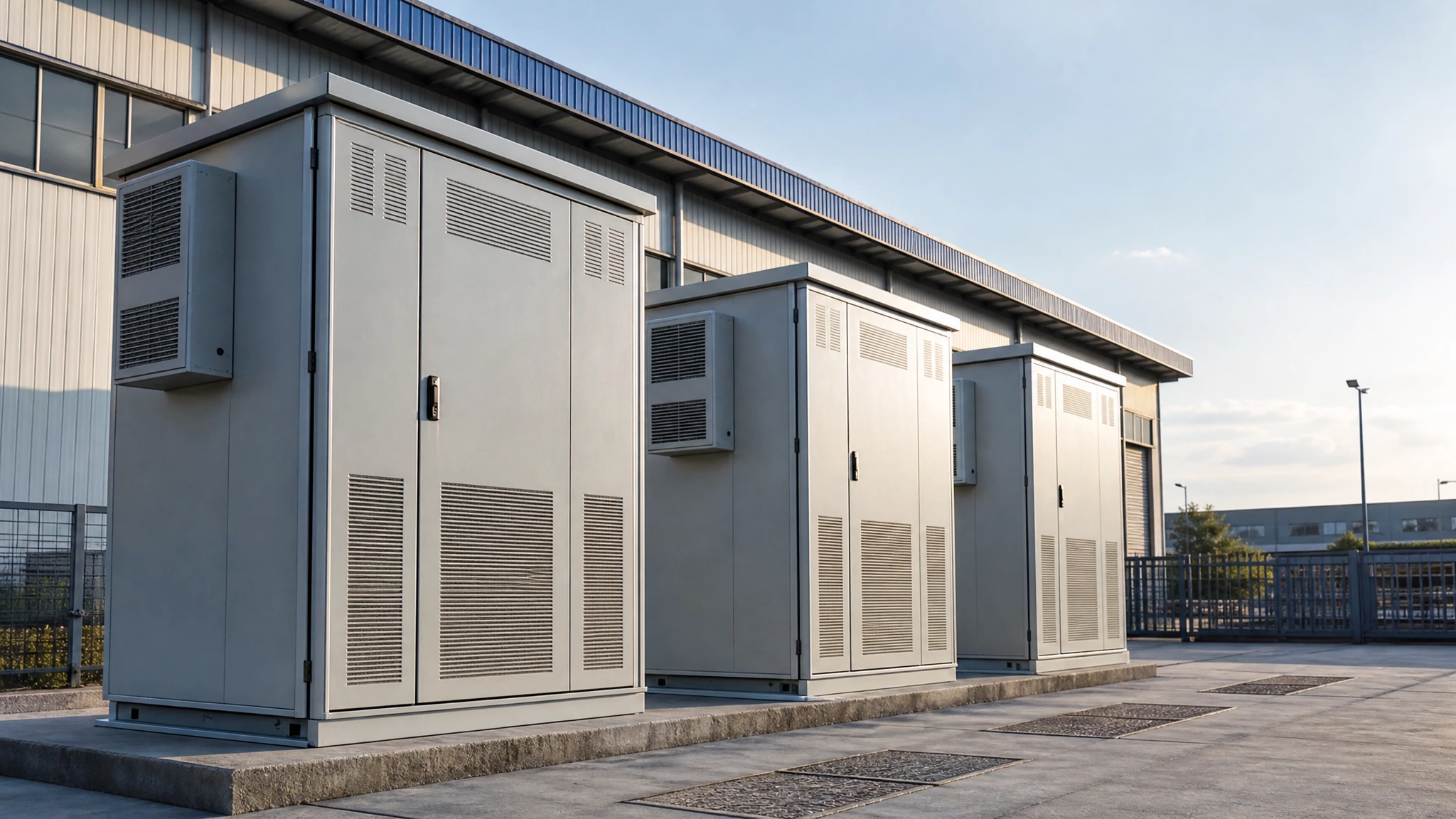
The fourth and most expensive error is treating storage as a battery purchase rather than a system design. The cabinet, the inverter, the thermal management, and the site's electrical infrastructure all constrain each other. A IP54 outdoor cabinet measuring 1271 × 1530 × 2120 mm with integrated air-conditioner and fan cooling operating from -20°C to +60°C solves the thermal and civil-work problem in one unit — but only if the footprint was checked before the order, not after.
Frequently Asked Questions
How long does a C&I storage system take to size properly? With interval data available, a first-pass sizing takes a few hours. Without it, allow two weeks for temporary logging before committing to a design.
Can I add capacity later? With a modular architecture, yes. The stacked-type series scales by adding modules and cabinets in parallel, so a first phase can be sized for current load and extended later without replacing the inverter.
What warranty period should I expect? The stacked-type series carries a 5+5 year warranty — five years plus a five-year extension — alongside CE and UN38.3 certification, which is the current baseline for outdoor commercial deployment.
Does the system need a separate building? Not necessarily. An integrated IP54 outdoor cabinet with active cooling is designed for direct outdoor installation, which removes the civil works and the footprint a containerised plant would require.
Which communication protocols should I confirm before ordering? Confirm CAN and RS485 support at minimum, since these are what connect the battery management system to mainstream inverters and energy management platforms. The stacked-type series also supports WiFi for monitoring.
Ready to size a system against your own load profile? Send Levin Power your interval data and the engineering team will return a cabinet count and a configuration proposal.