Single-Phase vs. Three-Phase Hybrid Inverters: How to Choose
Single-Phase vs. Three-Phase Hybrid Inverters: How to Choose Choosing between a single-phase and a three-phase hybrid inverter is usually presented as
Single-Phase vs. Three-Phase Hybrid Inverters: How to Choose
Choosing between a single-phase and a three-phase hybrid inverter is usually presented as a technical question. In practice it is a site question. The building's existing supply determines the answer more often than the load calculation does, and buyers who start from a power rating rather than from the service entrance routinely specify the wrong product.
This guide sets out the decision in the order it should be made: what the inverter does, how the two configurations differ, the site conditions that force each choice, then the three matching problems — PV array, battery bank, and backup load — that determine the final model.
What a Hybrid Inverter Actually Does
A hybrid inverter performs three jobs in one enclosure. It converts direct current from solar panels into alternating current for the building. It charges and discharges a battery. And it manages the flow between grid, solar, and battery so that the site uses its own generation before importing power.
The "hybrid" label refers to that third function. A grid-tied inverter only converts; a battery inverter only manages storage; a hybrid does both and arbitrates between them. That arbitration is where most of the value sits, because the sequence in which sources are used determines the electricity bill.
It is also where most of the engineering difficulty sits. The inverter must decide, second by second, whether to charge from solar, discharge to load, export to grid, or hold. It must do so while respecting battery limits, grid codes, and the site's own priority settings. When evaluating a hybrid inverter, the specification sheet tells you the hardware capability — but the firmware and the energy management logic determine whether that capability is actually usable.
Single-Phase vs. Three-Phase: The Core Difference
The distinction is about how alternating current is delivered, and it has practical consequences well beyond the wiring diagram.
A single-phase supply delivers power over one live conductor and a neutral, typically at 220, 230, or 240 volts. It is the standard for homes, small shops, and light commercial premises. A three-phase supply delivers power over three live conductors with a phase offset, typically at 380 or 400 volts, and it is the standard for industrial sites, larger commercial buildings, and any premises with substantial motor loads.
The consequence that matters most for inverter selection is per-phase balance. On a three-phase supply, loads are distributed across the three phases, and a single-phase inverter can only feed the phase it is connected to. If a site has a three-phase supply but a large single-phase load on one phase, that phase can be overloaded while the other two sit idle. A three-phase inverter spreads output evenly and avoids the problem entirely.
There is also a physical limit on single-phase capacity. Most utilities cap the maximum single-phase connection size, which is why very large residential systems often step up to three-phase even where the building could otherwise stay single-phase.
When Single-Phase Is the Right Choice
Single-phase is correct whenever the site's service entrance is single-phase. That covers most homes, apartments, villas, small retail units, and workshops. Specifying a three-phase inverter on a single-phase supply is not a matter of preference — the unit simply cannot be connected.
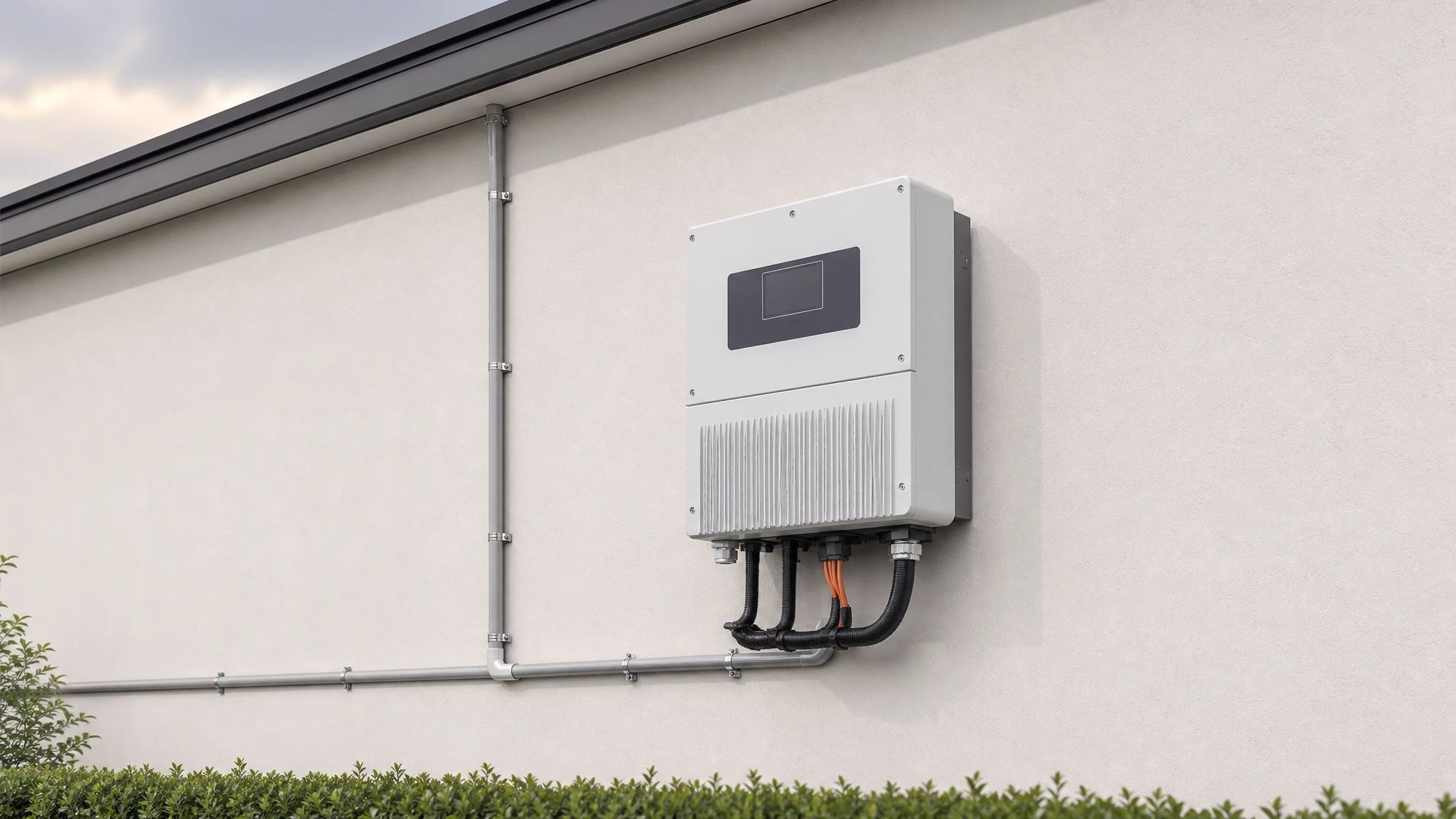
The Levin Power LPR-H16K-EU1-48PS is built for this segment: a 16,000 W single-phase hybrid operating at 220/230/240 V with a 48 V battery architecture and a 275 A charger. It carries three MPPTs configured as 2+2+2 strings, which lets a roof with three different orientations — east, south, and west — be tracked independently instead of averaged together.
That orientation flexibility is the underrated argument for single-phase hybrid in residential work. A villa roof is rarely a single plane, and the difference between tracking three orientations separately and treating them as one can be substantial across a full day.
Single-phase also wins on installation cost where the supply already exists. No service upgrade, no new switchgear, no utility application — the inverter connects to what is there. For retrofit projects, that saving frequently exceeds the price difference between the two product families.
When Three-Phase Is Mandatory
Three-phase becomes mandatory in three situations. The first is simply that the site already has a three-phase supply and the load is distributed across it. The second is a connection size above the utility's single-phase cap. The third is a load profile dominated by three-phase motors — pumps, compressors, HVAC plant, machine tools — which will not run correctly on a single-phase supply regardless of inverter capacity.
The EU3 series covers this ground from 15 kW to 24 kW, with three-phase output at 380/400 V in a 3W+N+PE configuration. Maximum PV input scales with the model, from 30 kW on the H15K to 48 kW on the H24K, all accepting PV open-circuit voltage up to 1,000 Vdc with an MPPT window of 150–850 Vdc.
That 1,000 Vdc ceiling is the specification that matters for commercial work, because it permits long high-voltage strings using 144-cell or larger modules. Fewer strings means less DC cabling, fewer combiner boxes, and fewer failure points on a large roof — a cost saving that shows up in the balance of system rather than on the inverter datasheet.
Matching the PV Array to the Inverter
PV array sizing is bounded at both ends, and exceeding either bound causes real problems.
The upper bound is DC input power. Oversizing the array relative to the inverter is normal and useful — it lifts yield on cloudy days — but beyond roughly 1.3 to 1.5 times rated AC output, clipping losses begin to erode the benefit. The EU3 series publishes generous ratios: 30 kW of PV on the 15 kW H15K, 36 kW on the 18 kW H18K, 40 kW on the 20 kW H20K, and 48 kW on the 24 kW H24K.
The lower bound is string voltage. A string must reach the MPPT window before it produces anything. On the EU1 H16K the window is 120–520 Vdc with a 550 Vdc maximum, so strings must be configured to stay inside that band across the full temperature range — cold mornings raise open-circuit voltage, and that is the condition that damages an over-long string.
Check both bounds against the actual module datasheet at the site's record low temperature. This is the single most common source of commissioning failures in hybrid systems.
Matching the Battery Bank and Charging Current
The battery side of a hybrid inverter is specified by voltage architecture and charge current, and both must match the battery actually being installed.
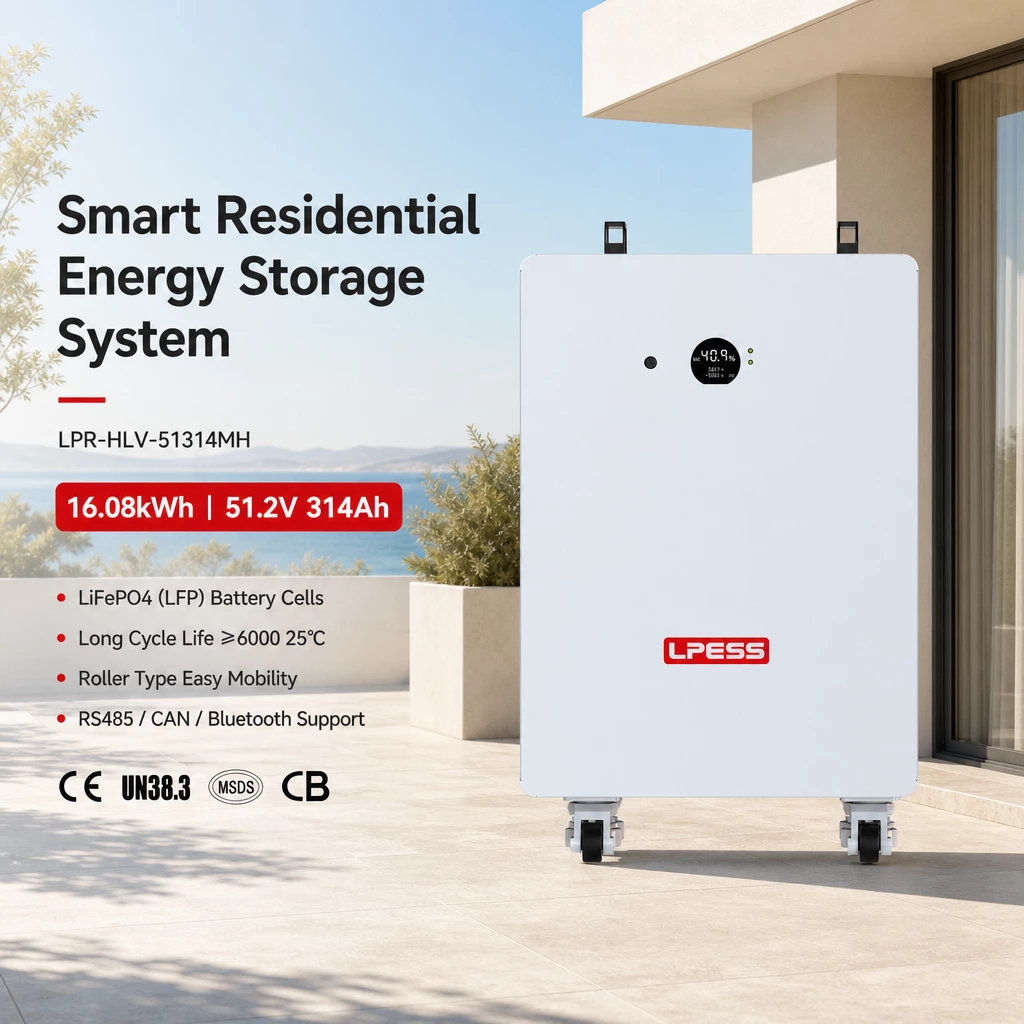
The EU1 H16K uses a 48 V battery architecture with a 275 A charger. That high charge current is what allows a large battery bank to be replenished within a short solar window — a smaller charger would leave the bank part-empty on good days and waste the array's output.
Confirm three things before ordering. First, that the battery's nominal voltage matches the inverter's architecture. Second, that the battery's maximum continuous charge current is at or above what the inverter can deliver. Third, that the communication protocol is supported — the system relies on CAN and RS485 to exchange state of charge, temperature, and limits between the battery management system and the inverter.
That last point is where mismatched components fail most often. A battery and inverter that are electrically compatible but cannot communicate will either refuse to operate or operate conservatively, and the site never sees the performance it paid for. Open protocol support on both sides removes the risk.
Reading EPS Specifications Correctly
Emergency power supply figures are quoted in ways that invite misreading, and the difference between them determines whether a site actually stays powered.
Two numbers matter: transfer time and overload capability. Transfer time is how long the inverter takes to switch from grid supply to battery supply when the grid fails. The EU1 H16K switches in under 10 milliseconds; the EU3 three-phase series switches in under 20 milliseconds. Both are fast enough that most equipment rides through, but a site with sensitive IT loads should confirm the figure rather than assume it.
Overload capability is the more frequently misunderstood figure. The EU1 H16K delivers 200% of rated output for up to 10 seconds and 150% for up to 60 seconds. The EU3 series adds a further tier at 110% for 600 seconds. These margins exist to start motors and other high-inrush loads — a compressor that draws three times its running current for two seconds will start on a correctly specified unit and trip on an underspecified one.
Read overload figures as a set of duration tiers, never as a single number. A specification that quotes "200% overload" without a duration is not a usable specification.
Certifications and Grid Codes by Market
Grid connection approval is market-specific, and an inverter certified for one country is not automatically approved for another. This is a procurement issue, not an engineering one, and it delays projects more often than any technical shortfall.
The EU3 three-phase series carries IEC 62109-1/2, IEC 62477-1, IEC 61000-6-1/3, and EN 50549-1 & -10. The EU1 H16K carries the same core set plus NRS 097-2-1 for South Africa, ABNT NBR 16149 for Brazil, and IEC 61727, IEC 61683, and IEC 62116.
That broader coverage is why the H16K is often specified for export projects spanning several markets — one certification package serves Europe, South Africa, and Brazil rather than requiring three separate product variants. Confirm the destination market's grid code against the certificate list before committing, and request the certificate documents rather than relying on a datasheet line. Ask for the certificate number and the issuing body at the same time, because utilities increasingly verify them against the issuer's registry instead of accepting a PDF supplied by the vendor.
A Practical Selection Checklist
Work through these in order. Most selection errors are caught by the first three.
Supply type. Read the service entrance. Single-phase or three-phase is a physical fact, not a design choice.
Connection size. Confirm the utility's maximum permitted single-phase connection against the required capacity. If it is exceeded, three-phase is the answer regardless of load shape.
Critical load power. If backup is in scope, the inverter's power rating must cover the critical load, not the total site load. These often differ by a large factor.
PV array window. Check string voltage at record low temperature against the MPPT range, and DC input power against the model's PV limit.
Battery compatibility. Confirm voltage architecture, charge current ceiling, and communication protocol — all three, not just the first.
Certification for the destination market. Match the certificate list to the actual grid code, and obtain the documents.
Enclosure rating. For outdoor installation, confirm the IP rating and the operating temperature range. The EU1 H16K is IP66 rated and operates from -25°C to +60°C, which covers both Northern European winters and Mediterranean summers without a separate enclosure.
Frequently Asked Questions
Can I install a three-phase inverter on a single-phase supply? No. The unit requires three live conductors and a phase offset that a single-phase supply does not provide.
Is a hybrid inverter worth it if I have no battery yet? Yes, if battery addition is plausible within the system's life. A hybrid inverter can operate without a battery and be commissioned with one later, which avoids replacing the inverter when storage is added.
What efficiency should I expect? The EU3 series reaches 98.00% maximum inverter efficiency with 99.90% MPPT efficiency; the H16K publishes 97.50% European efficiency. European efficiency is the more useful figure for real-world comparison because it weights part-load operation, not just the peak.
How long is the warranty? All models in both series carry a 5-year warranty as standard.
Can I parallel multiple inverters? This is model-dependent and should be confirmed against the specific datasheet and the intended topology before design. Do not assume parallel capability from the series name.
Sizing a hybrid system for a specific site? Send Levin Power your service details and load profile and the team will return a model recommendation with the matching PV and battery configuration.